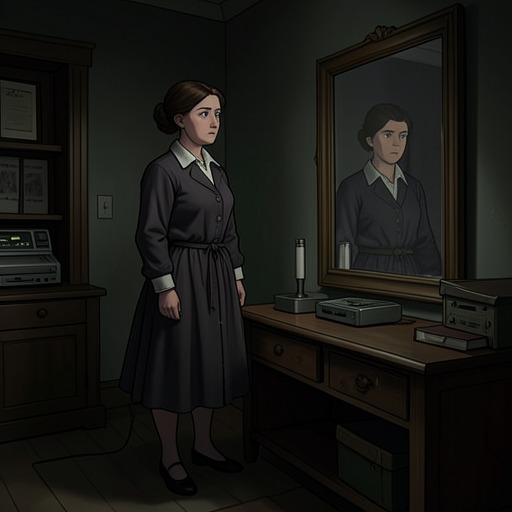
Ruth apologizes to Kathy and Tommy and gives them Madame’s address
Never Let Me GoRuth’s apology to Kathy H. and Tommy is a reversal of the role she had long played between them: she admits that she knowingly kept them apart, then gives them Madame’s address so they can try to obtain a deferral together. The event joins confession to practical action. Ruth cannot undo what she did, but she can name it, acknowledge the relationship she obstructed, and place a possible route forward in Tommy’s hands.
Causes and Background
Ruth has arranged the trip because she wants to say what she has been carrying and give Kathy H. and Tommy something. The disclosure follows a charged moment: when Kathy H. mentions Madame, she sees triumph flash across Ruth’s face and realizes the subject has opened new ground between them. Kathy H. braces for an attack, expecting Ruth to regain the advantage she once held. Instead, Ruth asks for forgiveness, first acknowledging that she lied when Kathy H. spoke about her sexual urges. She says she had considered telling the truth but did not, although she understood Kathy H. might later blame her for the silence.
That admission is only the beginning. Ruth identifies her separation of Kathy H. and Tommy as the worst thing she did. She says she had recognized, for as long as she could remember, that the two of them should have been together, yet she kept them apart. Her confession therefore revises the meaning of their earlier history: the obstacle was not simply circumstance or misunderstanding, but Ruth’s repeated intervention. She does not ask them to absolve her for that harm. Instead, she asks them to put right what she has damaged.
The Confession and the Address
Tommy asks what Ruth means by putting things right. His gentle, childlike puzzlement breaks through Kathy H.’s defenses and makes her sob. Ruth tells them that they should try to get a deferral as a couple, insisting that there is a real chance if the two of them apply together. Kathy H. rejects the suggestion as too late and shakes off Ruth’s hand when Ruth reaches to touch her shoulder. The exchange makes clear that remorse alone cannot restore the time Ruth took from them, and that Kathy H. is not ready to accept a promise of repair simply because Ruth now offers one.
Ruth has prepared more than an apology. She rummages in her anorak pockets and produces a crumpled piece of paper, telling Tommy to keep it for when Kathy H. changes her mind. He accepts it without understanding what it is. Ruth explains that it bears Madame’s address, connecting the paper to the possibility Tommy had discussed with her. She says finding it took a long time and involved risks, but that she obtained it for the two of them. The address turns regret into a specific opportunity: Ruth cannot secure a deferral herself, but she can put the means of approaching Madame into their hands.
Kathy H. has stopped sobbing by the time she starts the engine and insists that they end the conversation and get Tommy back. Ruth nevertheless asks them both to think about what she has said. The immediate result is not reconciliation neatly completed or a decision to pursue the deferral. It is a charged pause: Tommy has the address, Kathy H. remains resistant, and Ruth’s request is left with them after the trip ends.
What the Event Changes
The apology changes Ruth’s position in the triangle. Earlier, she had exercised control by keeping Kathy H. and Tommy apart; here, she openly names that control as wrongdoing and asks them to choose one another. Her gesture is not only emotional. She has taken the trouble to find Madame, endured risks to obtain the address, and placed the next decision with the two people she once divided. The paper’s modest, crumpled form contrasts with the weight of the possibility attached to it.
The scene also exposes the limits of repair. Ruth can confess and offer help, but she cannot make Kathy H. forgive her or restore the years already lost. Kathy H.’s refusal to accept the suggestion immediately keeps the harm present even as Ruth tries to counter it. The event’s turn lies in this combination: the past is finally spoken plainly, while the future remains uncertain. The deferral is a possibility to pursue, not an outcome secured by the apology.
Aftermath and Significance
Ruth’s concern for what follows continues after the trip. She asks Kathy H. whether she has considered becoming Tommy’s carer, an idea that gradually comes to stand in for the rest of the unfinished conversation. Kathy H. tells her she is thinking about it and that arranging such a change is not simple, while sensing that the question remains close to Ruth’s mind. This later wish extends the logic of the address: Ruth wants Kathy H. and Tommy brought together, not merely given a chance to seek a deferral.
Three days after Ruth’s second donation, Kathy H. is finally allowed to visit her in the early hours. Ruth is alone in a hospital room, in severe pain and largely inaccessible despite still being conscious. Kathy H. sits beside the metal bed, holds Ruth’s hand in both of hers, and stays as long as the staff permit. During a brief moment of lucidity, Kathy H. tells Ruth she will become Tommy’s carer as soon as she can. The promise answers the concern Ruth had voiced after the trip, making the confession part of a longer exchange of care rather than an isolated request for forgiveness.
As a remembered event narrated by Kathy H., the scene is shaped by the difference between what Ruth once withheld and what she can still give. Her confession cannot reverse the separation, and her address cannot guarantee a deferral; both acts matter because they acknowledge the truth and leave Kathy H. and Tommy with a choice. Ruth’s late gesture does not erase her betrayal. It changes what she does with the time and knowledge she has left.